Introduction
If you’re planning to build a website for your business, one of the first questions you’ll encounter is: Should I choose a static website or a dynamic website? It’s a common question-and an important one. The type of website you choose can affect everything from user experience and search engine rankings to maintenance, scalability, and future business growth.
Imagine you’re launching a startup, opening a restaurant, expanding a manufacturing company, or taking your retail business online. You invest in a website, only to discover a year later that it can’t support online bookings, customer logins, or new product pages without a complete redesign. On the other hand, you might invest in a highly complex website when a simple, fast-loading solution would have met your needs at a lower cost.
Choosing the right type of website from the beginning can save time, reduce development costs, and provide a better experience for your customers. Today, businesses in Chennai, Tuticorin, Tamil Nadu, and across South India are increasingly investing in digital transformation. Whether it’s a school, hospital, restaurant, ecommerce store, or service-based company, a website has become one of the most valuable business assets.
In this guide, we’ll explain the differences between static and dynamic websites, compare their advantages and disadvantages, discuss real-world business scenarios, and help you determine which option is best for your organization.
What Is a Static Website?
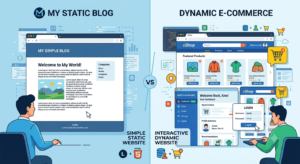
A static website is a website where each page is created using fixed content. Every visitor sees the same information unless a developer manually updates the website files.
Unlike dynamic websites, static websites do not retrieve information from a database or generate content in real time. Think of a static website as a printed brochure placed online. The content remains unchanged until someone edits and republishes it.
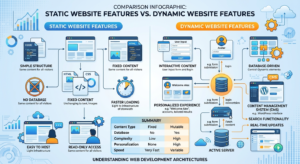
Common Features of Static Websites
- Fixed content
- Fast loading speed
- Simple architecture
- No database required
- Limited interactivity
- Easy hosting
- Lower development cost
Examples of Static Websites
Static websites are ideal for:
- Portfolio websites
- Company profile websites
- Personal websites
- Landing pages
- Event websites
- Small business websites with limited content
- Product showcase websites
For example, a local construction company in Tuticorin that only wants to display its services, contact information, and completed projects may find a static website sufficient.
What Is a Dynamic Website?
A dynamic website generates content automatically based on user interactions, stored data, or business logic. Instead of displaying fixed pages, dynamic websites use databases, server-side programming, and content management systems (CMS) to create personalized and interactive experiences.
For example, when you log into an ecommerce website and see your account details, order history, and personalized product recommendations, you’re interacting with a dynamic website. Popular platforms like WordPress, Shopify, Magento, and custom MERN Stack applications are all examples of dynamic website technologies.
Common Features of Dynamic Websites
- Database-driven content
- User login functionality
- Content management systems
- Search functionality
- Interactive forms
- Online payments
- Shopping carts
- Booking systems
- Personalized user experiences
Examples of Dynamic Websites
Dynamic websites are commonly used for:
- Ecommerce websites
- Educational portals
- Hospital management systems
- Restaurant ordering systems
- News portals
- Membership websites
- Online booking platforms
- CRM portals
- SaaS applications
- Business dashboards
Why Is Choosing the Right Website Important?
Many businesses assume that all websites work the same way, but the underlying technology directly impacts how your business operates online.
Selecting the wrong type of website can lead to:
- Higher maintenance costs
- Poor user experience
- Limited scalability
- Slow business growth
- Expensive redevelopment later
On the other hand, choosing the right solution offers several advantages:
- Better customer experience
- Easier content management
- Improved SEO performance
- Greater flexibility
- Support for future business expansion
- Better return on investment
As your business grows, your website should grow with it-not hold you back.
Static Website vs Dynamic Website: Key Differences
Understanding the core differences between these two website types can help you make a more informed decision.
Content Management
- Static Website – Content must be updated manually by editing individual pages.
- Dynamic Website – Content can be updated easily through an admin dashboard or CMS without modifying the website’s code.
Performance
- Static Website – Generally loads faster because pages are pre-built and served directly to users.
- Dynamic Website – May take slightly longer to load because pages are generated dynamically, although modern optimization techniques make this difference minimal.
Scalability
- Static Website – Best suited for small websites with limited pages.
- Dynamic Website – Designed to support business growth, allowing new pages, products, users, and features to be added easily.
User Interaction
- Static Website – Limited interaction beyond basic contact forms.
- Dynamic Website – Supports advanced features such as:
- User accounts
- Online bookings
- Ecommerce
- Live chat
- Customer dashboards
- Payment gateways
- Personalized content
Maintenance
- Static Website – Requires developer involvement for most content updates.
- Dynamic Website – Business owners can update content independently using platforms like WordPress or custom admin panels.
Common Problems Businesses Face
Choosing the wrong website type often creates challenges that become more apparent as a business grows.
Problem 1: Limited Scalability
A startup may initially choose a basic static website to save costs. However, as the business expands, it may need additional features such as online bookings, customer accounts, or ecommerce functionality. Adding these features to a static website can be complex and expensive.
Problem 2: Difficult Content Updates
Businesses that frequently update products, services, blogs, or promotions often find static websites difficult to maintain. Each change typically requires editing the source code, which can slow down marketing efforts.
Problem 3: Poor Customer Engagement
Modern users expect interactive experiences. Features like search, personalized recommendations, live chat, appointment scheduling, and customer dashboards are difficult or impossible to implement effectively on a traditional static website.
Problem 4: Limited Marketing Opportunities
Dynamic websites make it easier to publish blogs, optimize landing pages, and update SEO content regularly. Static websites may limit these opportunities, especially for businesses that rely on content marketing to attract organic traffic.
Problem 5: Future Growth Challenges
As businesses evolve, they often need integrations with CRM systems, payment gateways, analytics platforms, marketing automation tools, or AI-powered features. Choosing a website that cannot easily accommodate these technologies may result in costly redevelopment.
How to Solve These Problems
Selecting the right website starts with understanding your business goals-not just your current needs, but where you want your business to be in the next three to five years. A website should support your growth, simplify business operations, and provide a great experience for your customers. Let’s explore the best solutions based on different business requirements.
Solution 1: Choose a Static Website for Simple Business Needs
A static website is an excellent choice if your business primarily needs an online presence rather than advanced functionality. It works well for businesses that rarely update their content and only need to display information.
A static website is suitable for:
- Company profile websites
- Personal portfolios
- Consultancy firms
- Architecture firms
- Small manufacturing companies
- Event websites
- Product showcase websites
- Landing pages for marketing campaigns
Example
A civil engineering company in Tuticorin wants a website to showcase completed projects, company history, certifications, contact details, and service offerings.
Since the content changes only a few times a year, a static website provides:
- Fast loading speed
- Lower development costs
- Better security due to fewer moving parts
- Simple hosting requirements
For businesses with limited budgets and minimal content updates, a static website can be a practical and efficient solution.
Solution 2: Choose a Dynamic Website for Growing Businesses
If your business plans to expand its online presence, a dynamic website offers greater flexibility. Dynamic websites allow you to manage content without depending on a developer for every update.
Ideal for:
- Restaurants
- Schools
- Colleges
- Hospitals
- Clinics
- Ecommerce businesses
- Real estate companies
- Corporate organizations
- Service-based businesses
- Startups
Example
A restaurant in Chennai wants customers to:
- View the latest menu
- Reserve tables online
- Order food
- Leave reviews
- Receive promotional offers
- Subscribe to newsletters
These features require a dynamic website powered by a CMS or custom development framework. As customer expectations continue to evolve, businesses increasingly benefit from interactive websites that simplify customer engagement.
Solution 3: Choose WordPress for Business Websites
Many business owners wonder whether they should build a custom website or use WordPress. For many small and medium-sized businesses, WordPress provides an excellent balance between flexibility, affordability, and ease of management.
WordPress is ideal for:
- Business websites
- Schools
- Restaurants
- Healthcare providers
- Professional service firms
- Blogs
- Corporate websites
Benefits include:
- Easy content updates
- Thousands of plugins
- SEO-friendly structure
- Mobile responsiveness
- Secure user management
- Blogging capabilities
- Scalability
With proper optimization, a WordPress website can perform exceptionally well in search engines while remaining easy for business owners to manage.
Solution 4: Choose Custom Development for Complex Business Requirements
Some organizations require functionality beyond what standard CMS platforms can provide.
Examples include:
- ERP systems
- CRM software
- Online learning platforms
- Multi-vendor marketplaces
- Healthcare management systems
- Manufacturing dashboards
- AI-powered portals
- Business automation tools
These projects often require custom software development using technologies such as the MERN Stack.
Custom development provides:
- Greater flexibility
- Better scalability
- Tailored workflows
- Seamless third-party integrations
- Enhanced performance
- Improved security
For businesses planning long-term digital transformation, custom development can deliver significant operational advantages.
Solution 5: Prioritize SEO Regardless of Website Type
Whether you choose a static or dynamic website, SEO should be considered from the beginning of the project. A beautifully designed website has little value if potential customers cannot find it through search engines.
Key SEO practices include:
- Optimized page titles
- Descriptive meta descriptions
- Mobile responsiveness
- Fast loading speed
- Image optimization
- Internal linking
- Structured headings
- Schema markup
- Quality content
- Secure HTTPS implementation
Businesses in Chennai, Tuticorin, Tamil Nadu, and across South India can significantly improve local visibility by implementing strong Local SEO strategies alongside their website development efforts.
Business Benefits of Choosing the Right Website
Selecting the right website isn’t simply a technical decision-it directly impacts business growth, customer satisfaction, and long-term profitability.
Better Customer Experience
Visitors can quickly find the information they need, whether it’s product details, contact information, appointment booking, or online shopping. A smooth user experience encourages visitors to stay longer and take action.
Improved Search Engine Rankings
SEO-friendly websites are easier for search engines to crawl and index. Regular content updates, optimized page structures, and fast loading speeds contribute to improved visibility in Google Search.
Easier Content Management
Dynamic websites allow businesses to:
- Publish blogs
- Update services
- Add products
- Announce promotions
- Share news
without requiring technical expertise.
Increased Lead Generation
Modern websites guide visitors through the customer journey using:
- Contact forms
- Call-to-action buttons
- Live chat
- Appointment booking
- Newsletter subscriptions
These features help convert visitors into qualified business leads.
Greater Scalability
As your business expands, your website can evolve to support:
- Additional services
- New locations
- Ecommerce functionality
- Customer portals
- Mobile applications
- AI-powered features
Building with future growth in mind reduces redevelopment costs later.

Best Practices
Whether you choose a static or dynamic website, following these best practices will improve performance, usability, and search visibility.
Focus on Mobile-First Design
Most users now browse websites using smartphones.
Ensure your website:
- Adapts to all screen sizes
- Loads quickly on mobile devices
- Has readable typography
- Features easy-to-click buttons
- Provides simple navigation
Keep Content Fresh
Search engines prefer websites that remain active.
Regularly update:
- Blog articles
- Service pages
- Testimonials
- Portfolio
- Case studies
- Company news
Fresh content also improves customer trust.
Optimize Website Speed
Visitors expect pages to load within seconds.
Speed optimization includes:
- Compressing images
- Minimizing unnecessary scripts
- Browser caching
- Reliable hosting
- Content Delivery Networks (CDNs)
Fast websites improve both SEO and user experience.
Strengthen Website Security
Protect customer information by:
- Using HTTPS
- Installing SSL certificates
- Keeping software updated
- Using secure authentication methods
- Performing regular backups
A secure website builds credibility and protects your business.
Plan for Future Expansion
Ask yourself:
- Will I add ecommerce later?
- Do I plan to publish blogs?
- Will customers need login accounts?
- Will I launch a mobile app?
- Will I integrate AI or CRM systems?
Planning ahead helps you choose the right website architecture from the beginning.
Common Mistakes to Avoid
Many businesses make costly mistakes when selecting a website platform.
Avoid these common errors:
- Choosing the cheapest solution without considering future growth.
- Ignoring SEO during website development.
- Focusing only on design instead of functionality.
- Using outdated technology.
- Neglecting mobile optimization.
- Forgetting website security.
- Publishing duplicate or low-quality content.
- Selecting a platform that cannot scale with the business.
- Delaying website maintenance and updates.
- Ignoring user experience and accessibility.
Remember, your website is often the first impression potential customers have of your business. Investing in the right solution today can save significant time and money in the future.

Expert Tips from DigiMaraa Technologies
At DigiMaraa Technologies, we’ve worked with businesses across various industries and found that the “best” website isn’t always the most complex-it’s the one that aligns with your business goals.
For example:
- A local consultancy may thrive with a fast, SEO-optimized static website.
- A restaurant benefits from a dynamic website with online reservations and menu management.
- An ecommerce business requires a scalable platform with payment integration and inventory management.
- A manufacturing company may need a custom portal integrated with ERP or CRM software.
- A startup planning rapid growth should choose a scalable solution from day one.
Our recommendation is to evaluate your current needs, expected growth, budget, and long-term digital strategy before deciding between a static and dynamic website.
At DigiMaraa Technologies, we help businesses make informed decisions by offering:
- Website Development
- WordPress Development
- Software Development
- MERN Stack Development
- Ecommerce Website Development
- SEO Services
- Local SEO
- Google Ads
- Social Media Marketing
- UI/UX Design
- Branding
- Graphic Design
- AI Solutions
- Mobile App Development
- Digital Transformation Solutions
Rather than recommending a one-size-fits-all approach, we focus on creating websites that support business growth, improve user experience, and deliver measurable results.
Frequently Asked Questions
1. What is the main difference between a static and dynamic website?
The biggest difference lies in how content is delivered. A static website displays fixed content that remains the same for every visitor until it is manually updated by a developer. In contrast, a dynamic website generates content in real time using a database and server-side technologies, allowing it to display personalized or frequently updated information.
If your website needs features like user accounts, online bookings, blogs, or ecommerce, a dynamic website is generally the better choice.
2. Which is better for SEO: a static or dynamic website?
Both static and dynamic websites can rank well on Google when built correctly.
SEO depends on factors such as:
- High-quality content
- Website speed
- Mobile responsiveness
- Proper heading structure
- Optimized metadata
- Internal linking
- User experience
- Technical SEO implementation
Static websites often have a slight speed advantage, while dynamic websites make it easier to publish fresh content-an important factor for long-term SEO success.
3. Is WordPress a static or dynamic website?
WordPress is a dynamic Content Management System (CMS). It stores content in a database and generates web pages dynamically. This allows business owners to easily update pages, publish blog posts, manage media, and add new features without editing code. For many businesses, WordPress offers an ideal balance of flexibility, ease of use, and SEO capabilities.
4. Which website is best for small businesses?
It depends on your business goals.
A static website is suitable if you only need:
- Company information
- Service pages
- Contact details
- Portfolio
- Simple landing pages
A dynamic website is a better choice if you need:
- Regular content updates
- Blog management
- Online bookings
- Ecommerce functionality
- Customer logins
- Interactive features
If you’re planning to grow your business online, a dynamic website is usually the more future-ready option.
5. Are dynamic websites more expensive?
Generally, yes.
Dynamic websites require additional development, databases, and ongoing maintenance, which can increase the initial investment.
However, they often provide greater long-term value by supporting business growth, automation, and advanced functionality. Choosing the right website should be based on business requirements rather than development cost alone.
6. Can a static website be converted into a dynamic website later?
Yes, but it may require significant redevelopment depending on the original website architecture.
If you expect your business to expand with features such as ecommerce, customer portals, or content marketing, it’s often more cost-effective to build a scalable dynamic website from the beginning.
7. Which website loads faster?
Static websites are generally faster because pages are served directly to visitors without querying a database.
However, modern dynamic websites built with optimized technologies, caching mechanisms, and Content Delivery Networks (CDNs) can also achieve excellent loading speeds that satisfy both users and search engines.
8. How can DigiMaraa Technologies help choose the right website?
DigiMaraa Technologies begins every project by understanding your business goals, target audience, and future growth plans.
Based on your requirements, we recommend the most suitable solution-whether it’s a lightweight static website, a WordPress website, a custom MERN Stack application, or a fully integrated digital platform.
Our focus is on building scalable, SEO-friendly, and user-centric websites that support long-term business success.

Conclusion
Choosing between a static and dynamic website is not about deciding which technology is “better”-it’s about selecting the solution that best aligns with your business objectives, operational needs, and future growth plans. A static website is an excellent option for businesses that need a fast, secure, and cost-effective online presence with minimal content updates. It works well for portfolios, company profile websites, and small informational sites.
A dynamic website, on the other hand, is built for businesses that require flexibility, scalability, and interactive functionality. Whether you’re managing an ecommerce store, a restaurant with online reservations, a hospital appointment system, or a growing enterprise, a dynamic website provides the tools needed to support ongoing digital growth.
For businesses in Chennai, Tuticorin, Tamil Nadu, and across South India, investing in the right website architecture can significantly improve customer experience, search engine visibility, and overall business efficiency.
Before making your decision, consider these questions:
- How often will my website content change?
- Will I need a blog or news section?
- Am I planning to sell products online?
- Do I need user accounts or booking functionality?
- How do I expect my business to grow over the next few years?
Answering these questions will help you choose a website that meets both your current needs and your future ambitions.
For additional guidance and best practices, it’s also beneficial to refer to trusted industry resources such as:
- Google Search Central
- Google Business Profile
- Google Analytics
- Google Ads
These platforms provide valuable insights into website optimization, search visibility, and user behavior.
Your website is more than just an online presence
Your website is the digital foundation of your business. The right website can help you attract more visitors, generate qualified leads, improve customer engagement, and support long-term growth.
At DigiMaraa Technologies, we don’t believe in one-size-fits-all solutions. We work closely with businesses to understand their goals and recommend website solutions that are scalable, secure, SEO-friendly, and built for performance.
Whether you’re a startup, local business, educational institution, healthcare provider, manufacturer, restaurant, or ecommerce brand, our team can help you create a website that delivers real business results.
Our expertise includes:
- Website Development
- WordPress Development
- Software Development
- MERN Stack Development
- Ecommerce Website Development
- SEO Services
- Local SEO
- Google Ads Management
- Social Media Marketing
- UI/UX Design
- Branding
- Graphic Design
- AI Solutions
- Mobile App Development
- Digital Transformation Solutions
If you’re planning a new website or considering upgrading your existing one, DigiMaraa Technologies is ready to help you make the right choice with a solution tailored to your business goals. Let’s build a website that not only looks professional but also drives traffic, generates leads, and supports your business growth for years to come.